5 proofs of God’s existence
The period from the 13th to the 14th century saw remarkable developments in Christian thought in medieval Europe.

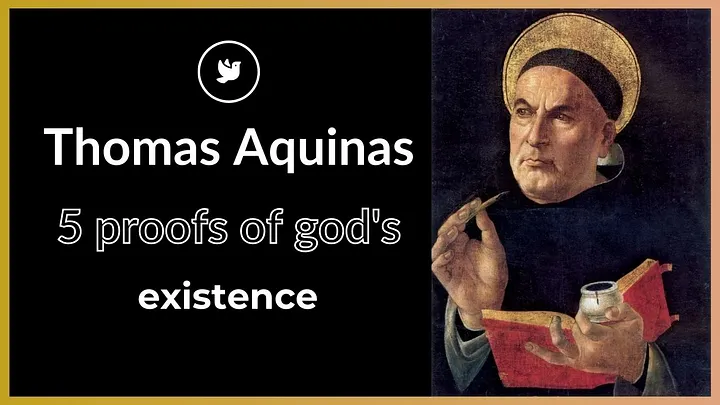
The period from the 13th to the 14th century saw remarkable developments in Christian thought in medieval Europe. Scholars and philosophers studied the treatises of ancient thinkers, including the works of such great minds as Aristotle and Plato. They were challenged to comprehend and reinterpret the ancient tradition and to create a system of scientific knowledge, which led to the founding of the first universities.
One of the significant results of this intellectual work was the Summa Theologica of Thomas Aquinas. This great work became a symbol of the synthesis of faith and reason, combining philosophical and theological aspects, and had a great influence on the further development of Christian thought.
Proof from the motion
-
Beginning of the proof: Thomas Aquinas begins with an observation about motion in the world. He says that many things in the world are in a state of motion.
-
Main argument: All motion, has a cause or source. He argues that nothing can begin to move on its own, but needs an external cause for its motion. For example, a ball rolls across the floor, it does so because someone or something exerted a force to make it move.
-
Application to potentiality and actuality: He uses the terms “potentiality” and “actuality” to explain that objects can be in a potential state of motion (e.g., wood that has the potential to burn), change to an actual state of motion (e.g., when the wood begins to burn) only by the action of another actual moving object (e.g., fire).
-
The logic of cause and effect: The cause of motion cannot itself be in motion, otherwise it would be both cause and effect, which is impossible. Thus, he concludes that there is a first cause of motion that does not itself move, and this first cause we call God.
Conclusion: There is an underlying cause of motion that does not itself move, and he calls this cause God.
Proof from reason
-
The beginning of the proof: We can observe the order of acting causes in the sensuous world. In no case can a thing be the cause of itself.
-
The logic of the sequence of causes: In an ordered sequence of acting causes, the first cause is the cause of all subsequent causes. If there were no first cause, there would be no last cause or any intermediate causes. Causes cannot go backwards indefinitely, otherwise there would be no beginning, no end, and no order in the sequence.
-
The necessity of a primary acting cause: It is necessary to arrive at the first acting cause, which we call God. This first cause itself does not need a cause because it is itself the primary cause of everything else.
Conclusion: There is a first acting cause, which we call God, and it is the beginning of the whole sequence of causes.
Proof from necessity
-
Beginning of the proof: Observable fact: There are things in the world that can exist or not exist. Some things are born and die, which shows that it is possible for them to be or not to be.
-
Argumentation: If everything in the world could possibly not exist, then at some point nothing would exist. However, if nothing existed once, then nothing should exist now either, since nothing could have begun to exist from nothing.
-
Necessity of Existence: There must exist something whose existence is necessary to provide the beginning of everything. If this were not the case, nothing would exist.
-
The contradiction of infinity: A series of causally contingent necessary entities cannot be infinite, as this would lead to illogicality. Therefore, there must exist something that does not need external conditioning and is necessary in itself.
Conclusion: There must exist something whose existence is necessary in itself and not through something else, and this we call God.
Proof from perfection
-
Beginning of the proof: By noting the different levels of perfection in the world, some things are more perfect, true, or good than others.
-
Argumentation: When we say that one thing is more perfect, we indicate that it approaches some ideal limit of that quality. For example, fire, as the hottest element, is the cause of hotness in other things.
-
The logic of perfection and cause: There must exist something absolutely true, good and perfect which is the cause of all other perfections in the world. God is the source of all perfections and entities.
Conclusion: There is something that is the cause of the existence, goodness and perfection of everything else, we call it God.
Proof from order
-
Beginning of the proof: Let us notice the order in the world, it is seen that things without reason, like natural objects, strive for a certain goal and often achieve it in the best possible way.
-
Directionality toward the goal: This directionality toward the goal is not random, but indicates a conscious will directing it. For example, an arrow reaches its target only because the archer directs it.
-
Lack of reason in things: Objects of nature, though striving toward a goal, do not have the reason to do so on their own.
-
Causality in the direction toward the goal: Something intelligent and conscious must guide natural objects toward their goals, just as an archer guides an arrow.
Conclusion: There must be an intelligent being guiding all natural things toward their purposes, this is what we call God.
Conclusion
The proofs for the Being of God are based on rational logic and reason, and primarily draw on the works of ancient thinkers. They aim to prove the existence of God in a general sense (the God of the philosophers) rather than in a Christian context. Thomas Aquinas masterfully summarized and systematized the intellectual heritage and brought it to its logical conclusion.