Blind leading the blind
Six blind people follow each other, each one holding on to the one ahead of them by holding on to a shoulder or a stick, the last one walks without much difficulty without feeling the danger, but the first one falls into a ditch.

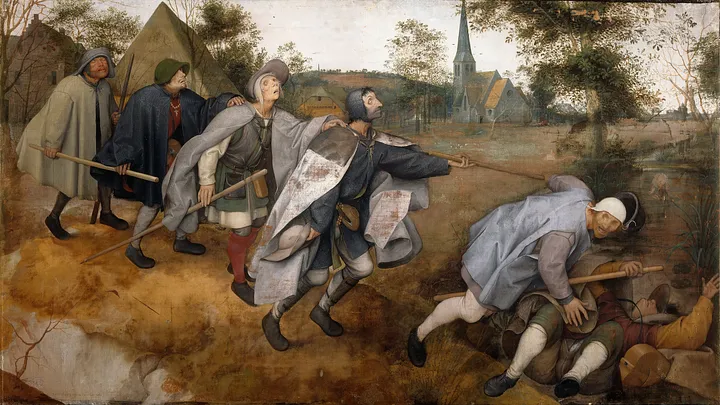
Six blind people follow each other, each one holding on to the one ahead of them by holding on to a shoulder or a stick, the last one walks without much difficulty without feeling the danger, but the first one falls into a ditch.
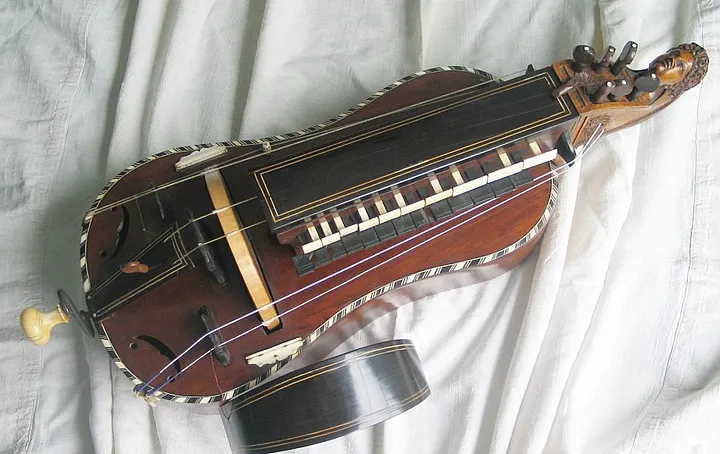 Hurdy-gurdy (Commons Wikipedia)
A wheeled lyre or hurdy-gurdy player falls into a ditch along with a musical instrument, the latter having the same musical instrument under his cloak.
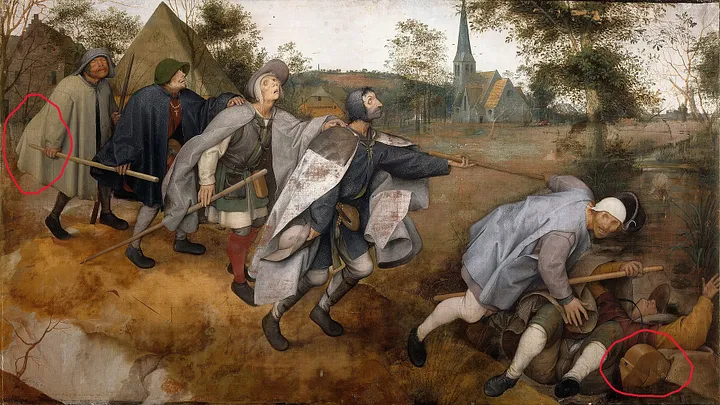 Hurdy-gurdy in the painting (Commons Wikipedia)
St. Anne’s Church
The events take place in the Barbantian district, which can be identified by St. Anne’s Church, located near Brussels. You can see how the place looks now on google maps by selecting a suitable place to view it, almost nothing has changed since those times except for the absence of the ditch into which the blind people move.
 St. Anne’s Church on google maps
The details in the background are visible, but the church of St. Anne is perfectly visible, moreover, the composition is built with emphasis on the church, which emphasizes its important role. The observer is in a position between the second and third walkers, and the terrible thing can happen only after the walkers are behind the church. The gaze is fixed on the second one, who seems to be looking at us with his empty eye sockets and has almost collapsed into the ditch after the musician.
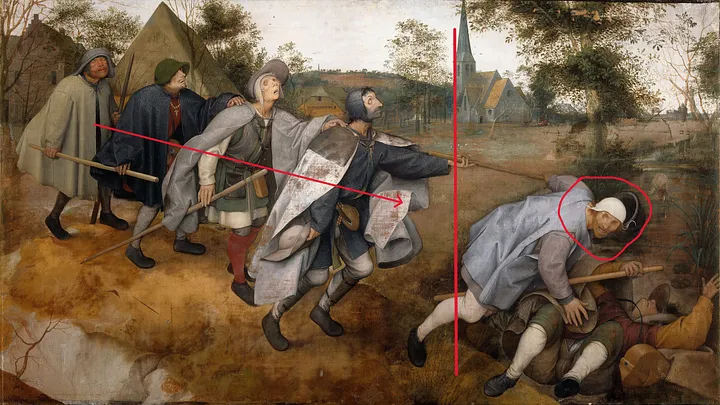 Danger after passing the church (Commons Wikipedia)
Parable of the Blind
It is impossible to imagine that the author depicted just a parade of maimed people, the meaning of this picture is of course quite different. The New Testament mentions the parable of the blind leading the blind three times, in the Gospel of Matthew Jesus addresses the Pharisees and speaks of the blind leading the blind, they get lost and fall into a ditch, in the Gospel of Luke the question arises what can happen if the blind lead others and whether they can avoid falling into the pit. The apostle Paul quotes the parable of the blind men in his letter to the Romans and concludes that formal knowledge of God’s laws is no guarantee of salvation.
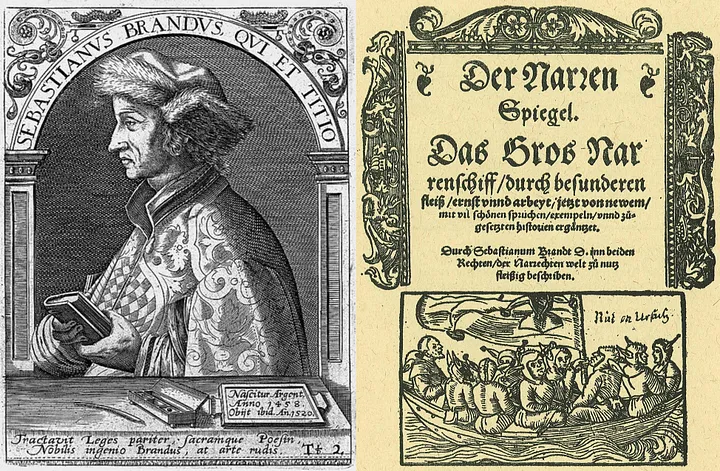 Sebastian Brant, the poem Ship of Fools. (Commons Wikipedia)
Since the Renaissance, the parable of the blind has been widespread, a reference to it can be found in Sebastian Brant at the beginning of chapter 40 in his work “The Ship of Fools”, where it speaks of the fall of fools who do not realize that they are fools.
Poor restoration and the Shepherd and his flock
Due to the poor restoration of the painting, an important part of the narrative was lost, but thanks to the surviving copies it is possible to understand what was depicted between the blind men and the church.
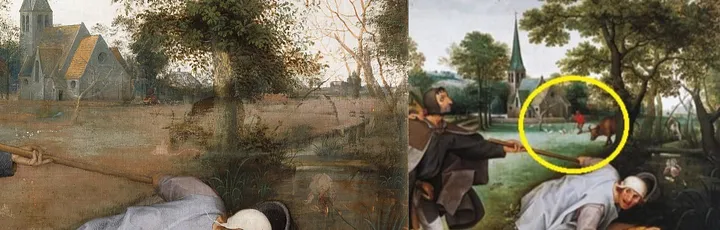 Poor restoration of the painting
There was a farmer with cows and geese who stands leaning on his cane and looks in the direction of the blind men not noticing that one of the cows has bent over to drink and is about to fall into a ditch. The fall of the blind and the animals allows an analogy to be drawn between the shepherd and his flock and the blind in trouble with the church.
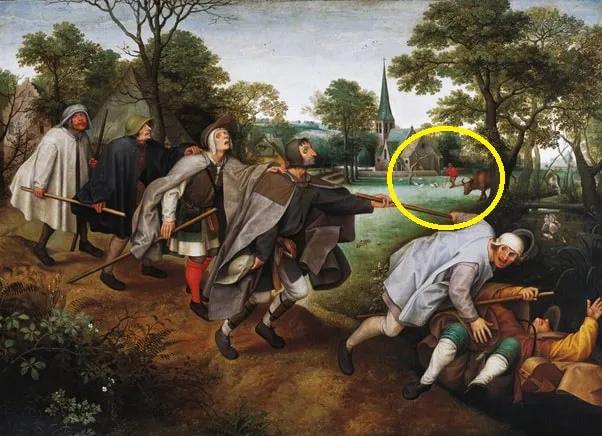 The Blind Leading the Blind is a 16th century copy.
The shepherd whose animals are close to falling into the ditch, in the role of the blind in the role of “shepherd” is the church too, leads the “flock” into the ditch, it turns out the church, leads the blind in the wrong and dangerous direction. The missing cross on the church steeple is certainly a bad sign.
The church leads the blind
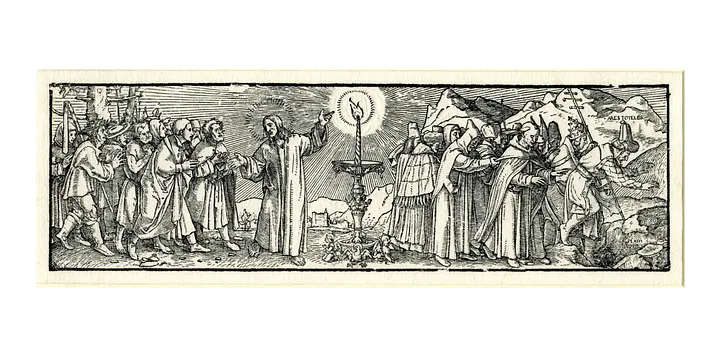 Hans Holbein the Younger, Christ as the True Light (1520–1525) (Commons Wikimedia)
An important analogy is Hans Holbein the Younger, Christ as the True Light (1520–1525). The subject is the Reformation, on the left a group of Protestants follow Christ and the “true light”, on the right Catholics go in the wrong direction despite the ancient wisdom of Aristotle and Plato and eventually fall into a pit. This reference contains important confessional content at the time of the Reformation and links the story to the parade of the blind. Prior to Bruegel, the parable of the blind was often used to condemn religious denominations, Luther often referring to the Pope of Rome as leading the blind.
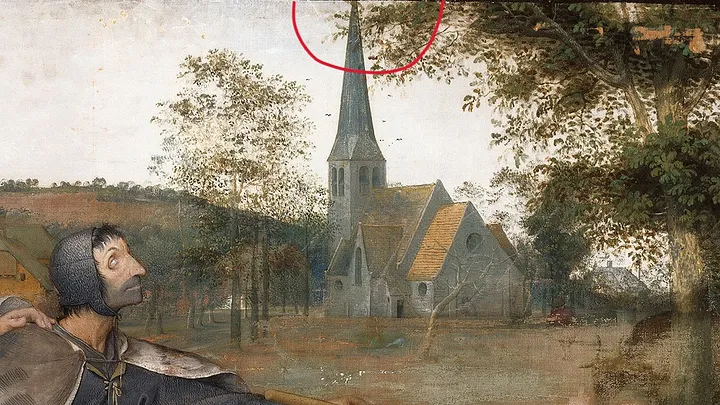 The steeple on the church is missing (Commons Wikimedia)
It is hard to imagine that the missing cross on the steeple is an accident by the author, the cross has often been used as a symbol of true faith. The church is analogous to the shepherd leading the blind, in trying to find God everyone is blind, they can easily stray from the right path, if people have faith it does not guarantee them an infallible path, the wrong path can be taken through sectarian strife and heresy. Bruegel depicts not personal mistakes in relation to Christianity, but mistakes related to religious conflicts. The author opens the way for self-knowledge and introspection so that we can understand the world full of religious errors, misconceptions and heresies, and warns us not to let this happen to us.
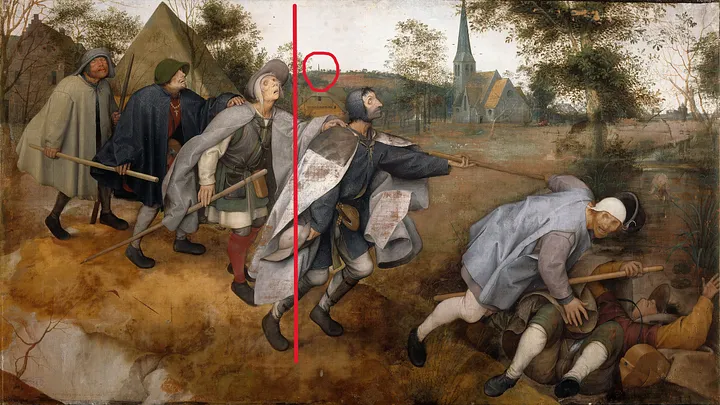 The steeple of another church will divide the blind into those who are close to falling and those who can still be saved (Commons Wikimedia)
There is no cross on the near church, but on the other church the cross is present and can be seen on the church that is far away on the hill. This steeple divides the blind into those who are very close to falling and those who can still be saved. Perhaps this is a warning to the observer who is in the position of the third from the right who is very close to falling, but it is not yet possible to say for sure whether he will fall or not.
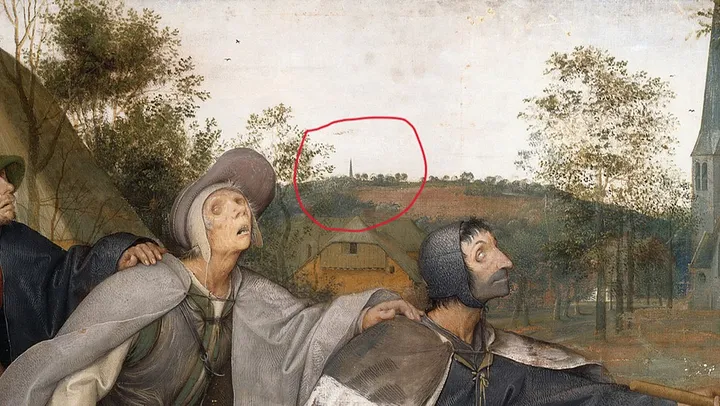 The steeple of a church on a hill in the distance (Commons Wikimedia)
As we can see the metaphor of the blind leading the blind was used extensively in Christendom. The Swiss cultural historian Jacob Burckhardt (1818–1897) writes excellently:
“Bruegel’s work The Blind Leading the Blind gives us the idea that enormous mistakes happen in history. Anyone who looks into the empty eye sockets of the falling man cannot simply forget it. His lifeless eyes will show us not only the horror of his fall, but also the shock of realizing his own guilt.”
How relevant this sounds in our time.