All the pictures in Lars von Trier’s Melancholia
In this article we will look at all the paintings present in Lars von Trier’s Melancholia.

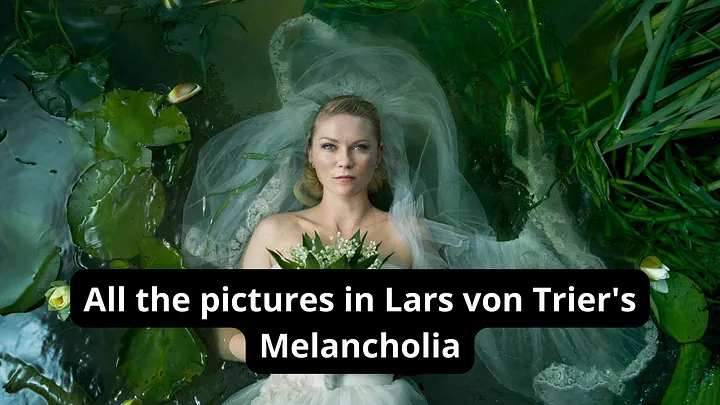
In this article we will look at all the paintings present in Lars von Trier’s Melancholia. It includes well-known works of art as well as rarely seen paintings. Every scene in the film is riddled with symbols and references that give it deep meaning. Let’s explore the paintings that Lars von Trier uses to give his work extra meaning and beauty.
Hunters on the Snow
At the very beginning of the film, we encounter shots that have deep meaning and are related to the story. Great attention is paid to the painting Hunters in the Snow by Peter Brueghel Sr. which is shown in close-up. Subsequently, this painting burns before us, turning into burning debris and ash. Perhaps the director chose this scene to emphasize that this painting is the main symbol of the film.
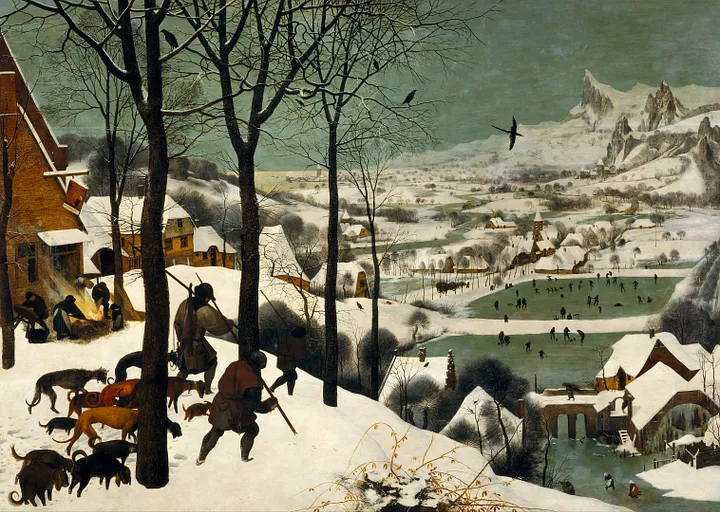 Hunters on the Snow, Pieter Bruegel the Elder, 1564–1565
The main motif in the paintings is the bird trap in the center. It can only be seen with a closer look. The symbol of the bird-catcher in the Bible is associated with the presence of the Devil. Birds, according to ancient tradition, symbolize the human soul. We can find a reference to this in the Old Testament, in Jeremiah chapter 5:
“For among my people are those who are wicked: they keep watch like fowl-catchers, they lay hold of the ground, they set traps, and they catch men. Like a cage filled with birds, their houses are full of deceit.”
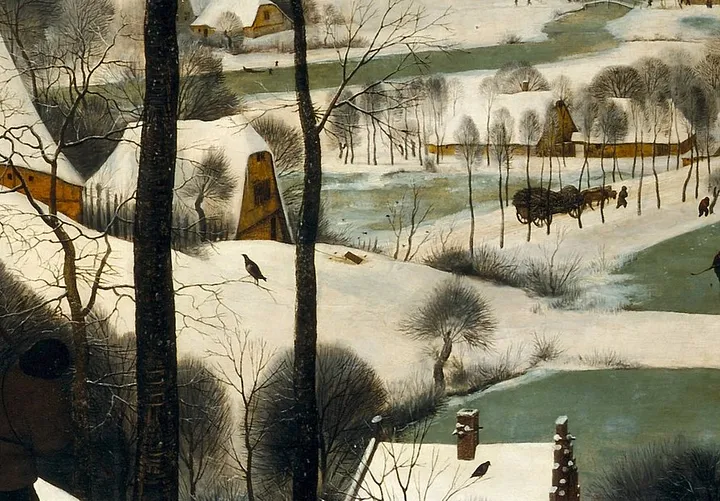 Hunters on the snow (fragment of a bird trap)
The film is divided into two parts: the first is called “Justin” and the second is called by her sister’s name, “Claire”. However, in my opinion, the film is not only divided officially into two parts, but also unofficially by a scene where Justin is flipping through books in the library. Initially, the scrapbooks open to pages featuring modern paintings from the Art Nouveau era, such as works by Malevich in the style of Futurism, Cubism or Cubo-Futurism. Justine turns the pages and we see other paintings, among which “Snow Hunters” reappears. On one page she also finds paintings of Sir John Everett Millais’ Ophelia and The Woodsman’s Daughter.
Ophelia and the Woodsman’s Daughter
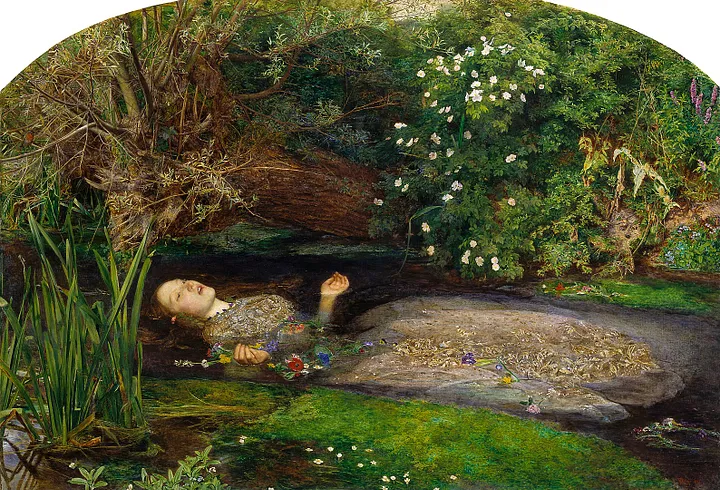 Sir John Everett Millais, Ophelia, 1851–52
“Ophelia” is a scene, captured by the artist, from Shakespeare’s play “Hamlet, Prince of Denmark,” where Hamlet kills Ophelia’s father and she, losing her mind, throws herself into a stream and drowns. At the beginning of the film, Justin appears as Ophelia floating down the creek in her wedding dress. You can read an article about this picture for a more detailed analysis of its significance.
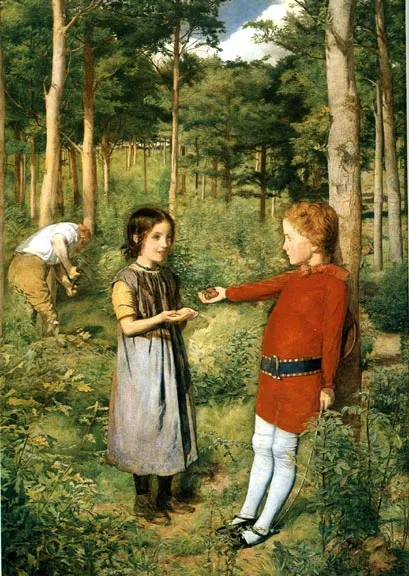 Sir John Everett Millais, The Woodman’s Daughter, 1851
The story in Coventry Patmore’s poem “The Woodsman’s Daughter” tells of a boy from a wealthy family who falls in love with the daughter of a woodsman. They have mutual feelings, but their love proves to be hampered by class restrictions and he cannot take her as his wife. Eventually she drowns the child she gives birth to and drowns herself. Both of these stories end tragically and are great examples of the tragedy genre.
These two pictures, Ophelia and The Woodsman’s Daughter, also deepen the symbolic and tragic atmosphere of Melancholia. They add even more drama and allow the viewer to get a sense of impending disaster and horror.
The Land of Cockaigne
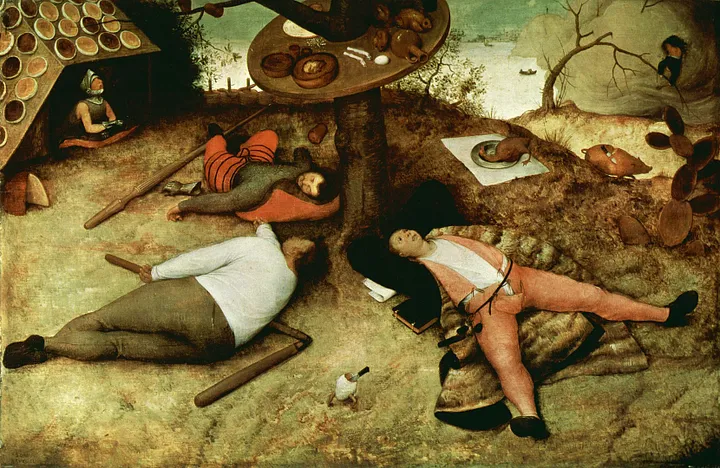 Pieter Bruegel the Elder, The Land of Cockaigne, 1567
The literary tradition of the land of Cockaigne has its roots in the Middle Ages. It is a fictional world, an idyllic abode of carnal pleasures. It is a false Paradise or Paradise for bums. In the center of the painting are three fat men lying around a circular table, which probably revolves, serving the bums. A milk river can be seen in the background. In the upper left corner, a soldier in armor just opens his mouth, expecting food to fly into his mouth on its own.
Perhaps Lars von Trier is using this image as a symbol of a modern world full of material goods, abundant food and excess. The film may convey the idea that modern man lives in a false Paradise that makes him worse off. By satisfying all of this person’s needs, we create an infinite number of new needs, often invented specifically to satisfy them. In other words, one might suggest that this picture in the film serves as a critique of a consumer society that needs to be destroyed.
This portrayal of Cockaigne land by Lars von Trier’s art can be used to provoke reflection on the consequences of an excessive consumerist lifestyle and show that true happiness and mental well-being are not achieved through material possession, but require profound changes and a rethinking of values.
Portrait of Georg Giese
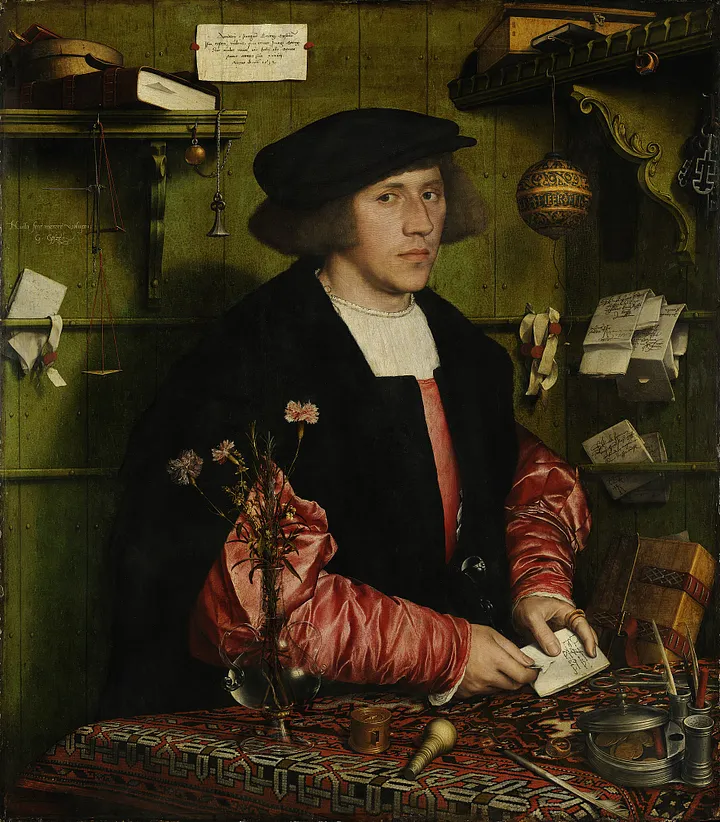 Hans Holbein, the younger, Portrait of Georg Giese, 1532
Seeing Georg Giese’s portrait in the film, next to the picture “Land of the Lazy”, may have its own meaning. Georg Giese was a member of a prominent and wealthy merchant family. The members of the Hanseatic League represented a new type of merchant class that began to dominate trade in Europe in the 14th and 15th centuries. They engaged in large-scale international trade, importing and exporting goods over long distances. These merchants occupied a significant position on the world stage, establishing permanent offices in major cities and running their trading empires.
Perhaps in the context of the film, Lars von Trier is using the image of Georg Giese as representative of the world of the “Land of the Lazy”, where people get all the wealth without any effort. It could be a commentary on the ideas of a consumer society, where some people, like members of the rich merchant class, get privileges and wealth without working for it. It can be a critique of the unfair distribution of resources and the problem of inequality.
However, as with the other interpretations in the film, this is only one possible interpretation and symbolic meaning of the image of Georg Giese.’
A Negro hung alive by the Ribs to a Gallows
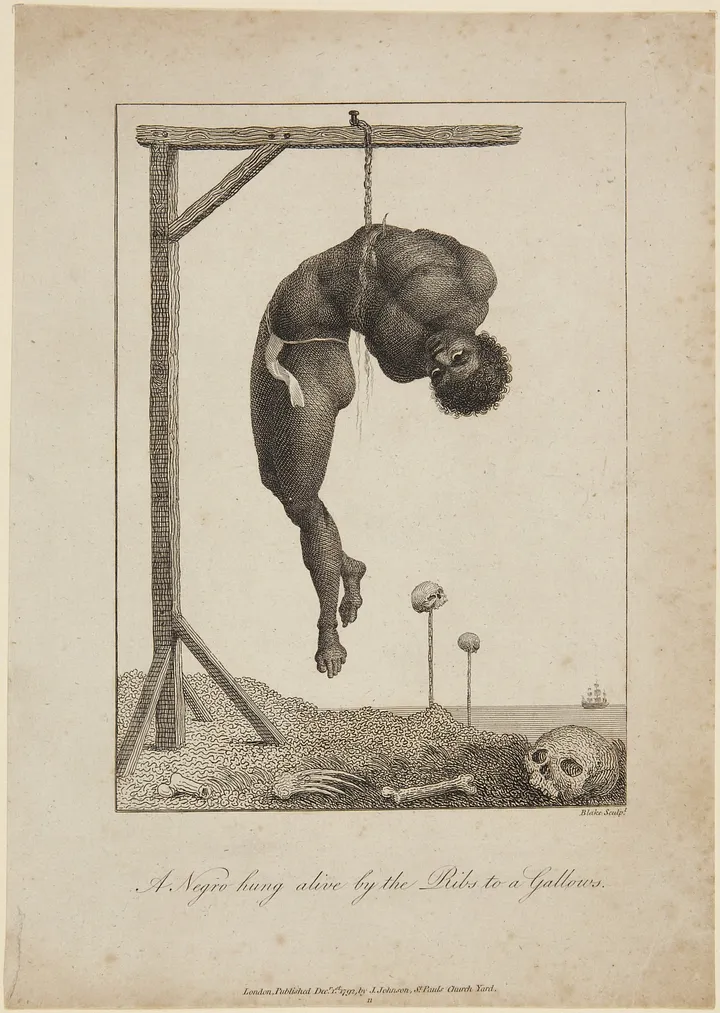 Negro hung alive by the Ribs to a Gallows, William Blake, 1738–1809
[The inclusion of the engraving](”https://artmuseum.princeton.edu/collections/objects/3251 The inclusion of the engraving”) next to the album, which contains a portrait of Georg Giese and the painting “Land of the Lazy”, can be interpreted as an allusion to the consequences of colonization and the activities of large trading companies. In this context, Georg Giese can be presented as a symbolic image related to the guilt of killing the local population during colonization. Behind the outward luxury and wealth is the suffering and death of many people.
This interpretation allows us to see the film in the context of social and historical problems related to colonialism and resource exploitation. It can be a critique of a system in which the few gain enormous wealth while many people suffer and become victims of that system.
However, it is important to note that a film can have many layers of interpretation and symbolism, and each viewer’s interpretation can be unique.
David with Goliath’s Head
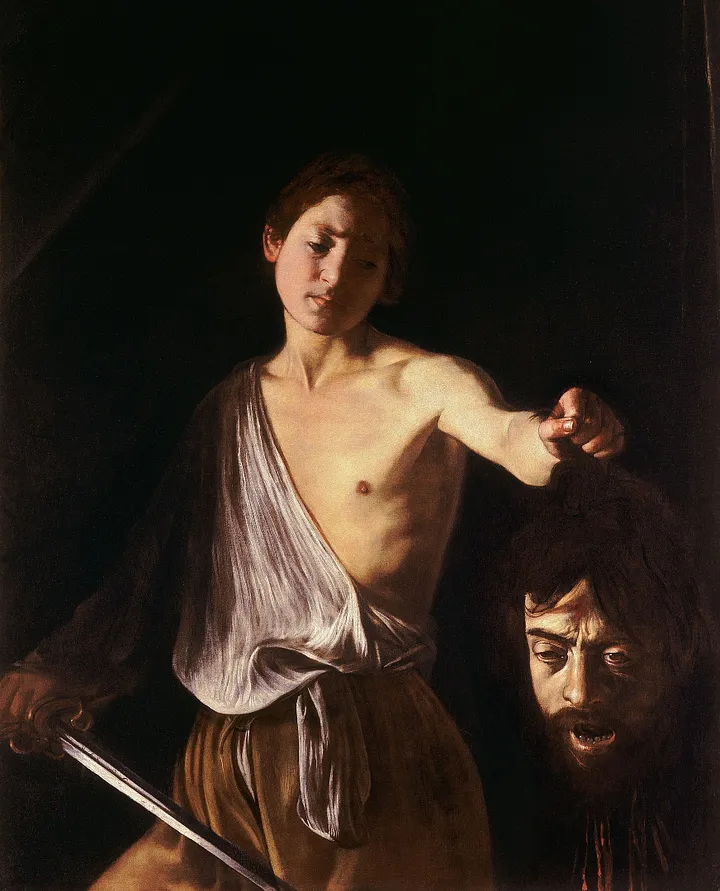 David with the Head of Goliath, Caravaggio, 1610
The painting depicting David defeating Goliath and holding his severed head is a biblical scene from the Old Testament. In this scene, the young David, a representative of goodness and faith, defeats the Philistine warrior Goliath, a symbol of evil and the enemy. The painting illustrates the moment of David’s victory and emphasizes the theme of the victory of good over evil.
Compositionally and artistically, the painting captures the viewer’s attention with its drama, illumination, and power of expression. The dark shadows enveloping David’s face and body create a contrast with the bright light, which enhances the effect and drama of the scene.
In the context of the film, where Justin is flipping through the albums and this picture appears last, we can assume that it alludes to the fact that evil will be destroyed. Justin refers to evil as life on earth, and this picture may symbolize the hope of the disappearance of evil and the arrival of prosperity. It can be interpreted as an expression of belief in the victory of good over the dark and negative forces that are present in the world.
The Garden of Earthly Delights
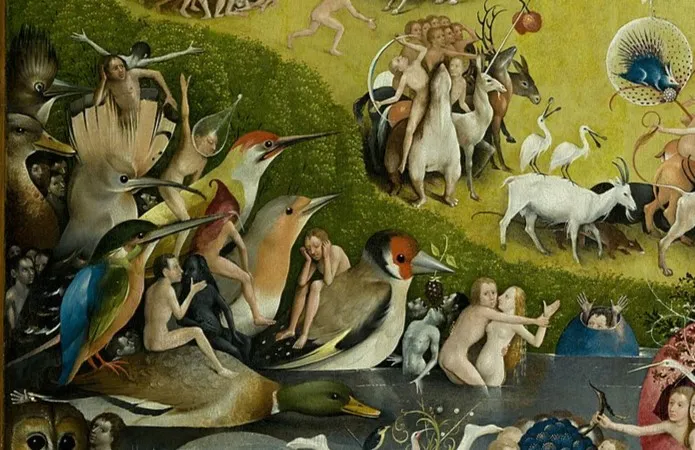 Hieronymus Bosch, The Garden of Earthly Delights (left side center panel fragment
Hieronymus Bosch’s triptych The Garden of Earthly Delights is indeed one of the strangest and most enigmatic paintings in the history of art. This triptych is a vast gallery of bizarre images and terrifying scenes, including a depiction of Hell. The fragment that appears in the library in the second part of the film refers to the left edge of the center panel next to Paradise, but most of the figures on it are facing Hell, and it is supposed to depict humanity before the Flood.
The use of this fragment from Bosch’s triptych in the film may have various symbolic and thematic meanings. It can serve as a commentary on the fall of mankind and its sinfulness, as well as reflecting the theme of destruction and ruin. Bosch’s painting is known for its detail and abundance of bizarre creatures and scenes, which may emphasize the diversity and complexity of the world in which the film unfolds.
Conclusion
The appearance of the snow hunters after Justin reveals the paintings in the scrapbooks may be a sign of a revival of the medieval notion of the end of the world and the expectation of the end times. The comparison between medieval times and modern times may indicate that humanity is still vulnerable to vice and evil, and has failed to learn lessons from the past.
Justine, in the film, acts as a medium with access to profound meanings and spaces inaccessible to ordinary people, may indicate her special role. Her belief that life on Earth is an evil that must be destroyed may reflect the Gnostic view of the world of the early first millennium. As we know, the Gnostics believed that this world was arranged by the “wrong” God, the best way out was to escape from this world.
It is important to note that “Melancholia” is a film with many symbolic and metaphorical elements, and each viewer can perceive it in his or her own way. The interpretation of the film and its symbolism remains a subject of discussion and reflection.