Two Chained Monkeys by Pieter Bruegel
Of all of Bruegel’s works, “Two Chained Monkeys” exhibits the simplest composition but not the simplest meaning.

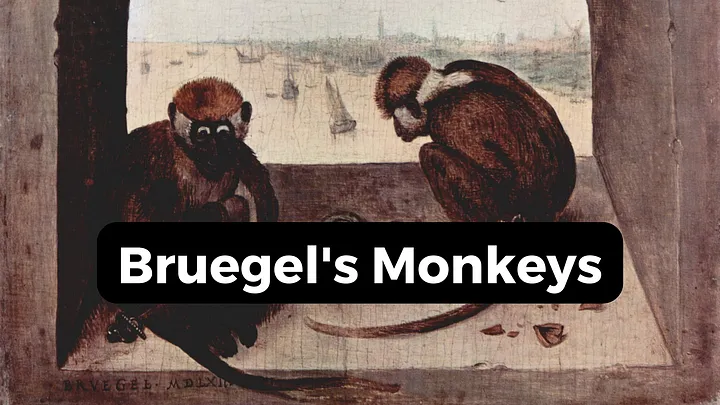
Of all of Bruegel’s works, “Two Chained Monkeys” exhibits the simplest composition but not the simplest meaning. Two monkeys sit in a window recess, behind them a panorama of a city and a bay unfolds. One of the monkeys gazes at us, while the other looks ahead at the window niche. The animals are chained to a large iron ring in the middle. In the background, the outlines of a bustling city are visible, with the shapes of houses and several church spires. The monkey’s tail at the bottom obscures the artist’s signature, possibly implying that the author associates himself with these animals.
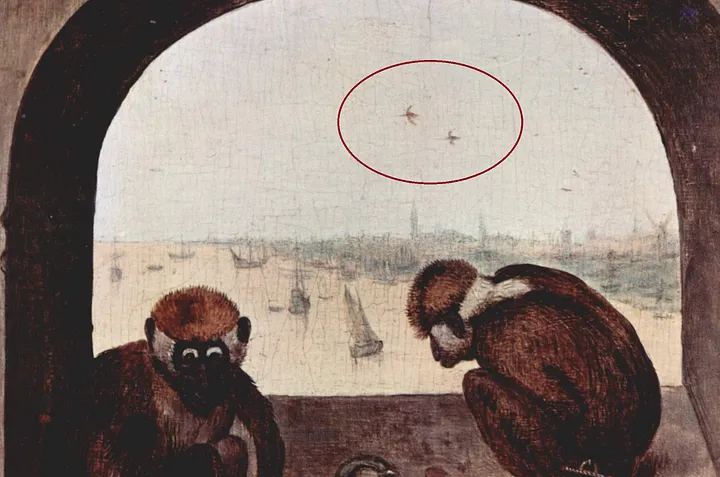 Two Chained Monkeys(fragment)
The monkeys in the foreground are positioned parallel to two birds in the sky. Nearby, on the window sill, there are scattered walnut shells, indicating that they were eating them. The ships in the harbor are at anchor with their sails down.
The composition is constructed around parallel narratives: the window niche and the city panorama, the two monkeys, and the two birds soaring in the sky. The well-lit cityscape in the background stands out against the massive walls of the window niche where the captives — the monkeys — are seated.
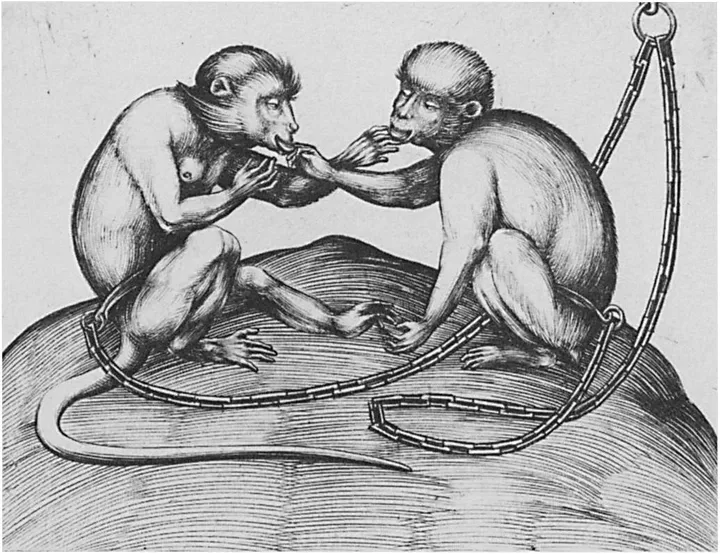 Israhel van Meckenem, Two Monkeys, 1500
Many images of monkeys by 16th-century artists can be found, often with the intention of depicting animals for study, and sometimes with references to sin. However, the monkeys depicted by Bruegel have a unique concept; they are physically and psychologically separated, creating the impression that they might represent the same monkey portrayed in two different variations.
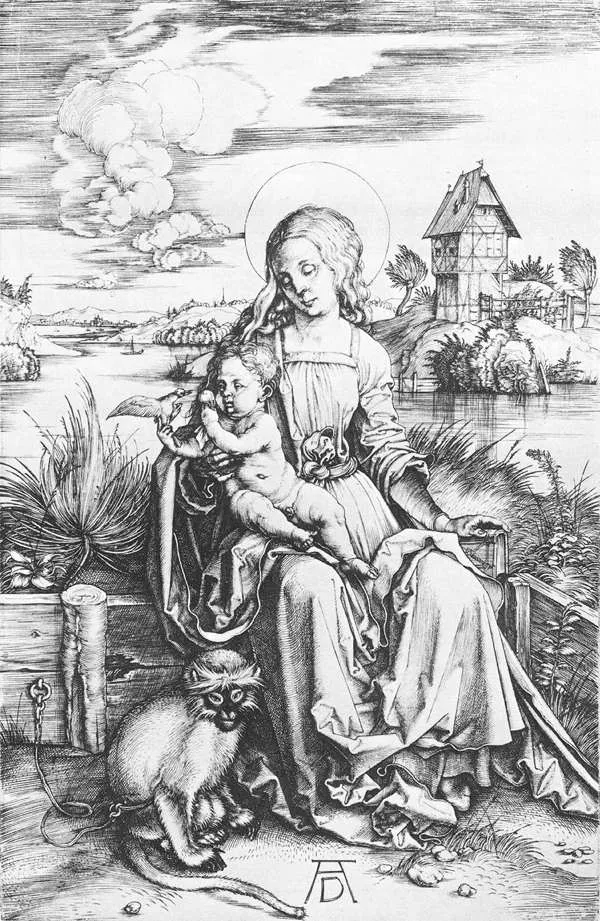 Albrecht Dürer, Madonna with a monkey, 1496–1498
Albrecht Dürer’s works were widely distributed and admired in the Netherlands, which gives reason to believe that Bruegel was familiar with them. In this context, a monkey is chained to a fence upon which the Virgin Mary and the infant Christ sit. Erwin Panofsky(1) suggested that the monkey represents the base aspect of human nature, in contrast to the spiritual life represented by the Virgin and child. The message conveyed by this mournful animal is that sin leads to bondage and sorrow. Dürer’s monkey, which gazes directly at the viewer, is akin in form and spirit to Bruegel’s left-hand monkey.
Placing Bruegel’s “monkeys”(7) in a broader context, one can conclude that the imagery in this painting is connected to the “monkeys” of the 16th century, in which monkeys were used to convey the sinful life. During this period, as extensively documented, the primary role of the monkey was to represent the irrational and foolish side of human nature. In the literature of the time, sermons, and proverbs, the “monkey communicated” the idea of evil and foolishness in contrast to good and virtue, often associated with the devil. Luther even believed that monkeys were “diaboli,” devils themselves.
Sebastian Franck(2) spoke of “monkeys” who “scatter everything like true apostles of the Antichrist.” When writers needed a vivid negative image for their opponents, the monkey, contrary to goodness and beauty, became a potent symbol.
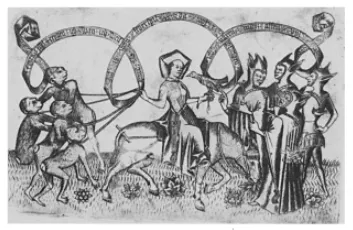 School of the master of playing cards, Dame Folly, Bayerische Staatsbibliothe
The monkey holds an important role in the history of the portrayal of foolishness. This portrayal reached its peak in the first half of the sixteenth century. In Sebastian Brant’s “The Ship of Fools”(3), Dame Venus (or Lady Folly) leads monkeys and fools on a rope (circa 1450). Dame Folly says she catches many “fools and monkeys,” emphasizing their kinship. Monkeys symbolize those even further along the path to damnation than the fools.
In medieval literature, monkeys were often depicted negatively, usually in contexts related to selfishness, sin, and vice. The contrast between the two monkeys and the birds can be seen through an ancient tradition where birds serve as symbols of the human soul. In the book of the prophet Ezekiel(4), you can find:
Therefore thus says the Lord GOD: ‘Behold, I am against your magic bands with which you hunt the souls like birds, and I will tear them from your arms; and I will let the souls whom you hunt go free, the souls like birds.
So, the birds symbolize the souls, while the monkeys represent those mired in foolishness and sin. This contrast between the two groups highlights the spiritual and moral aspects of the painting.
Indeed, in the Psalms(5), you can find the following passage:
We have escaped like a bird from the snare of the fowlers; the snare is broken, and we have escaped.
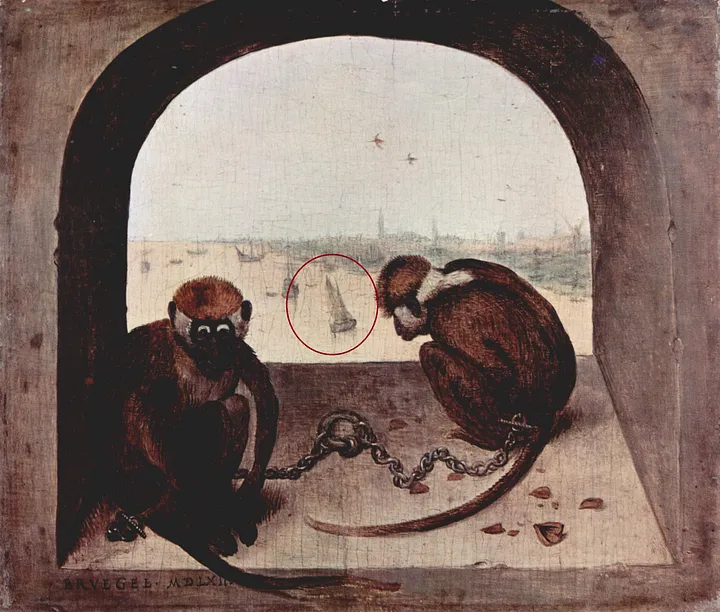 Two fettered apes (ship)
Bruegel indeed uses Christian symbolism to depict the harbor, with only one ship in the center under sail reaching the harbor, symbolizing “salvation.” On the contrary, the monkeys are bound by chains of “sensibility,” and the possibility of “salvation” is hidden from them.
The author may be presenting us with a symbol of the Christian worldview, which involves an awareness of the limitations of our understanding of the world, where true knowledge is hidden even from the most knowledgeable individuals. Like the monkeys, humans are bound by the chains of sensuality and cannot have direct access to the transcendent.
We may think we are looking at monkeys, but in reality, we are looking at ourselves because we occupy the same position on Earth as they do. From this, it follows that we should exercise moderation in our pursuit of knowledge about God, as human nature is bound by certain limitations.
Sebastian Franck(6) in his “paradoxes” writes:
Oh, this mighty God is hidden from us; He turns all the wise and rich into objects of ridicule, and those who possess wealth into paupers, mocking their riches, and He seats all the errant children of humanity on a bench with monkeys.
It’s indeed possible that Sebastian Franck’s phrase “on a bench with monkeys” could have inspired Bruegel in the creation of this panel. In this sense, the idea could be that all of humanity is on the same bench as the monkeys but prefers not to notice it, highlighting the shared human traits and limitations that are often overlooked or denied.
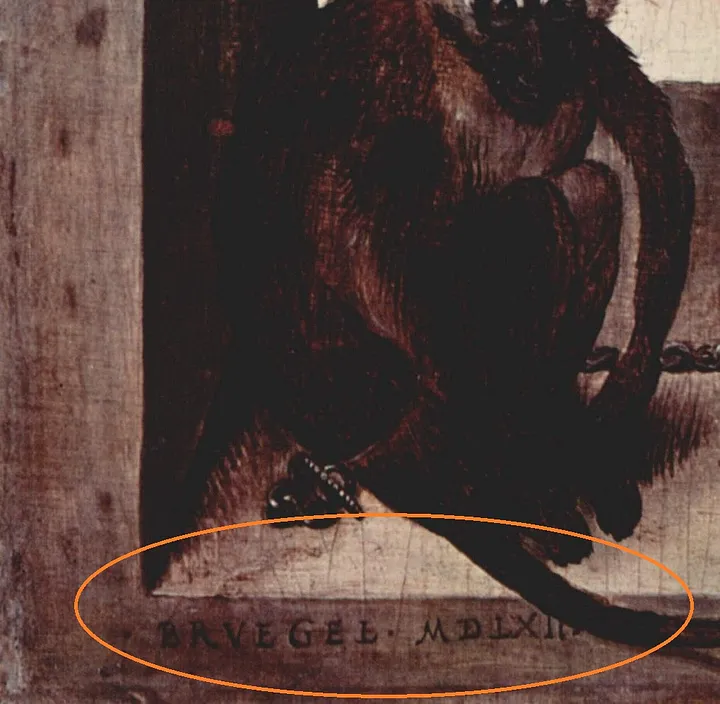 Two fettered apes (author)
The painting indeed conveys the inevitable binding of the limitations of our understanding of reality and God. By placing his name beneath the monkeys, the author hints that he too is bound by these constraints. All he can do is depict a parallel between human nature and the symbol of the salvation of the human soul. The transcendent cannot be depicted; we can only seek the boundary between the real and the divine.
Bibliography:
- E. Panofsky, “The Life and Art of Albrecht Dürer,” Princeton, NJ., 1955, p. 67.
- G. Williams, “Spiritual and Anabaptist Writers,” Philadelphia, 1957, p. 153, from Sebastian Franck’s letter to John Campanus, Strassburg, 1531.
- Text and reproduction in Zeydel trans. “Ship of Fools,” p. 88.
- For Janson’s discussion, see pp. 206–07.
- Ezekiel 13:20.
- Psalms 123:7.
- Sebastian Frank: “Paradoxa,” ed. Siegfried Wollgast, Berlin, 1995.
- “Peter Bruegel the Elder’s Two Monkeys: A New Interpretation” by Margaret A. Sullivan, The Art Bulletin, Vol. 63, №1 (Mar., 1981), pp. 114–126.